



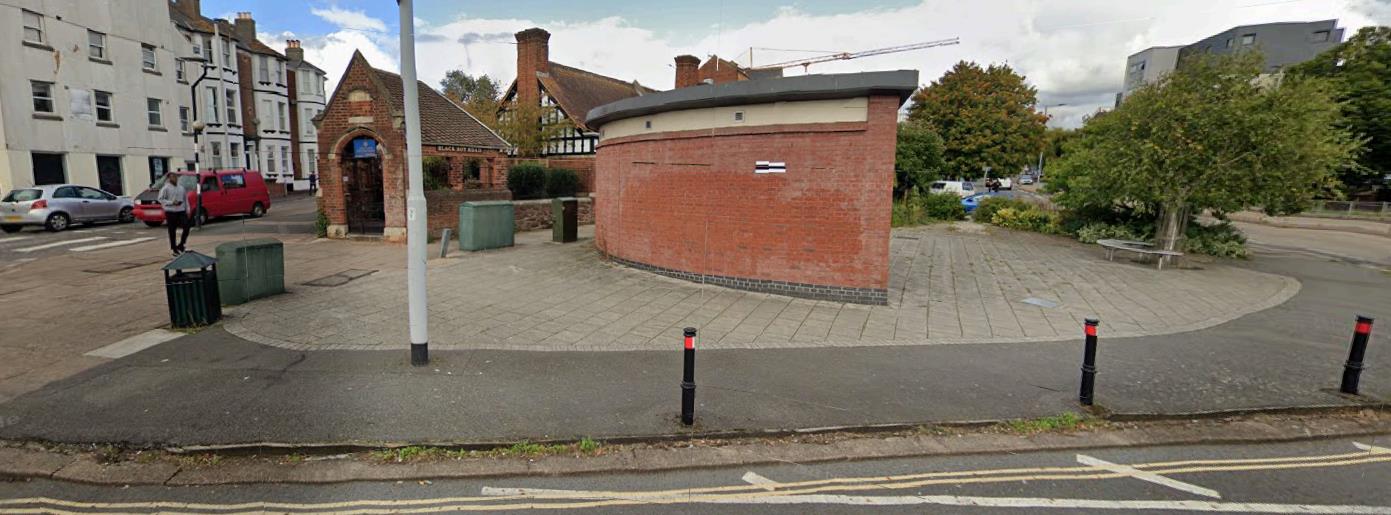
A disused public toilet block at one of Exeter’s key gateway junctions could soon be transformed into a vegetarian street food outlet, under fresh plans submitted to Exeter City Council.
The application, lodged by Ahmad Hammad, seeks full planning permission for the “change of use from former public toilets to an outdoor café/hot food takeaway” at the Public Convenience site on Blackboy Road, within the Belmont Conservation Area. The building has stood vacant since the council closed the toilets in 2019.
According to the Planning Statement prepared by Base Planning Consultants, the proposal would retain and convert the existing curved, single-storey brick building rather than demolish it. The site sits on the roundabout junction of Blackboy Road and Old Tiverton Road, approximately 700 metres north-east of the city centre.
Internally, the former toilets would be reconfigured to provide “a serving area, kitchen and accessible W/C”, with no indoor customer seating proposed.
Externally, the four former entrance doors on the east elevation would be replaced with a serving hatch window, while sections of render and vertical timber cladding would be introduced. A mural is proposed for the road-facing west elevation, and anti-graffiti coating would be applied to protect the building.
Six solar panels would be installed on the existing zinc-clad roof, “arranged to follow the curvature of the roof.”
A modest, detached bin store and storage building would be constructed to the south-east of the main structure, designed to echo the original curved form and mono-pitched roof. The two buildings would be linked by a semi-circular canopy, while retaining a walkway between them.
The business, to be known as Falafelco, is described in the accompanying Business Plan as “a fresh, healthy, and entirely vegetarian street-food takeaway.” The menu would include falafel wraps, halloumi dishes and salad boxes, with no meat products handled or sold.
The café would operate between 10am and 9pm Monday to Saturday and 10am to 6pm on Sundays and public holidays . Outdoor seating would be available from 10am to 8pm on weekdays and Saturdays, and until 6pm on Sundays and public holidays, with all furniture stored securely outside those hours.
The Planning Statement stresses that “no late-night activity is proposed and no amplified music will be played internally or externally” . It also states that, “by virtue of the nature of the intended use there is no requirement for any external extraction equipment.”
Refuse and recycling would be stored within the new structure and presented for collection on designated days . The Business Plan adds that bins would be presented “strictly outside of business operating hours and peak pedestrian times.”
A CCTV camera and burglar alarm are proposed “in effort to prevent fear of crime at and near to The Site.”
The site lies within the Belmont Conservation Area and near to several listed buildings, including St Anne’s Almshouses and chapel. The Planning Statement notes that the building is identified in the Conservation Area Appraisal as having a “neutral impact”, while the wider site is classed as a positive space.
The application follows the refusal of an earlier, larger scheme in August 2024 (reference 24/0604/FUL), which proposed demolishing the existing 25.5sqm structure and replacing it with a substantially bigger café building of around 95sqm, along with enclosed seating and a brick bin store.
The refusal notice stated that the proposal was “contrary to section 12 and 16 of the NPPF” and several local policies because, among other reasons, “by virtue of its design, scale, and massing, the proposal would be an unsympathetic development, which would be harmful to the established character of the Conservation Area.”
It also concluded that the scheme would harm the setting of nearby listed buildings and have “unacceptable harm to the amenities currently enjoyed by the adjoining properties.”
The current submission argues that careful consideration has been given to that decision and that the revised plans retain the existing footprint, limit additional massing and preserve openness around the site.
In relation to the previous scheme, Exeter Civic Society said it agreed that, “if successful, this proposal could reanimate this neglected space”, but raised concerns about bin storage, signage and the potential impact on pedestrian movement.
Devon and Cornwall Police said it had “no objection to the proposal and welcome that it will provide some legitimate use and ownership of the space”, while recommending clearly defined seating, secure bin storage and the consideration of CCTV .
Devon County Council’s highways department concluded that refuse collection arrangements would be acceptable, noting that bins would need to be moved approximately 35 metres to a collection point and that this would be “a betterment over collections on the network that could potentially lead to highway safety concerns.”
The Planning Statement argues that the proposal complies with policies in the adopted Core Strategy and Local Plan, including those relating to meeting community needs, food and drink uses, design and heritage protection. It concludes that the scheme would “deliver an appropriate use, within a suitable location, preserving the character of designated heritage assets and their setting whilst contributing positively to locality.”