



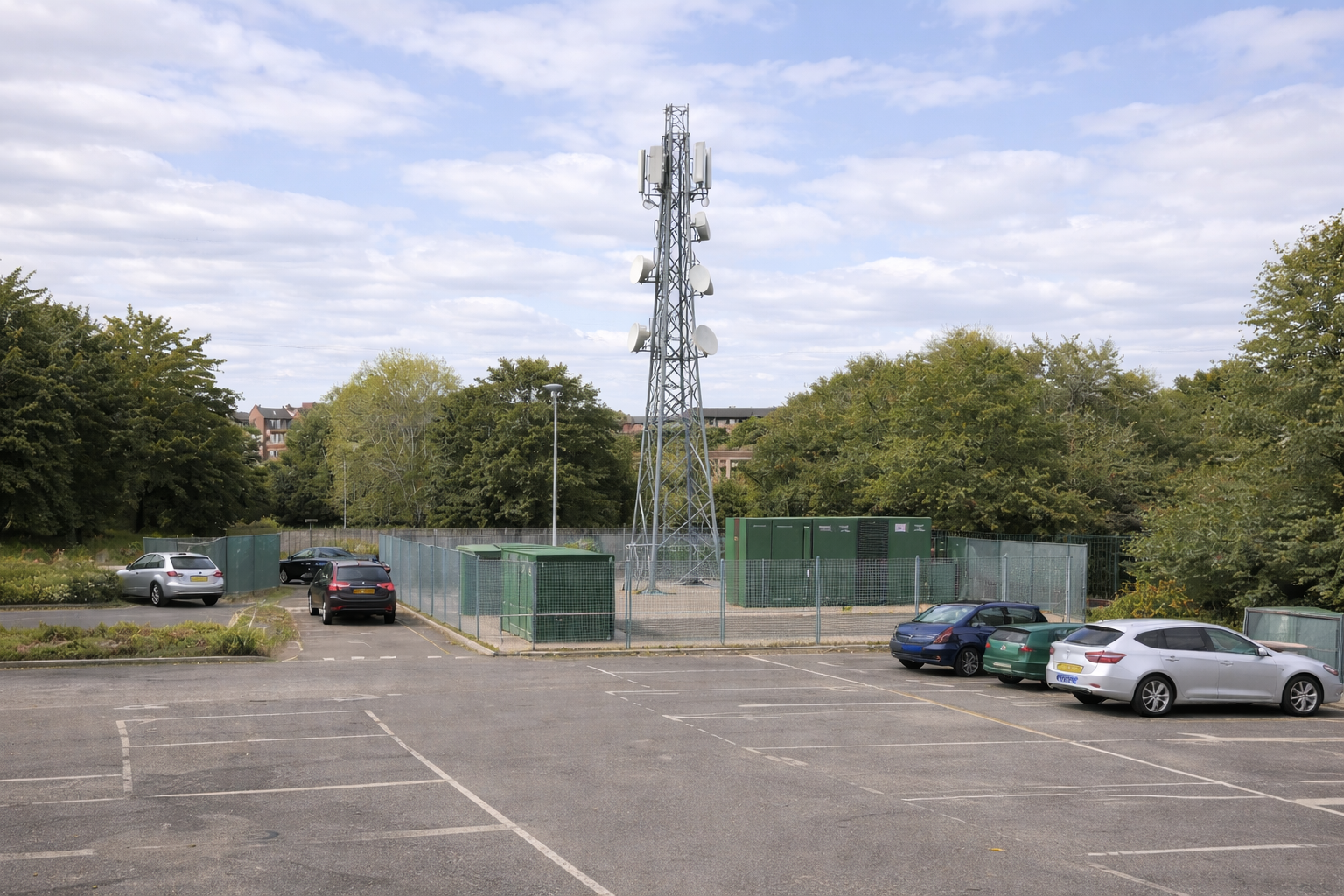
Plans have been lodged to install a 25-metre lattice telecommunications tower at the Isca Arena car park in Exeter, in a move aimed at boosting 4G and 5G coverage across the city.
The application, submitted to Exeter City Council by EE Limited and H3G (UK) Limited under prior approval procedures, seeks permission for a “25m lattice tower with six antenna apertures, four 600mm transmission dishes, four equipment cabinets and development ancillary thereto inside an 11m x 11m compound enclosed by Cochrane Clearvu fencing with a double access gate.”
The proposed site is described as Saracens South, Exeter Arena, Whipton. The development would be contained within a secure compound measuring 11 metres by 11 metres.
According to the covering letter submitted with the application, the existing telecommunications apparatus serving the area is currently located on the rooftop of Rennes House, approximately 670 metres south west of the proposed site. However, the document states that “the site is no longer viable as the rooftop is no longer capable of hosting telecommunications equipment.”
As a result, EE (UK) Ltd and H3G (UK) Ltd say they need to find a replacement site “to offset this shortfall in coverage in the vicinity to ensure that network coverage and capacity can be maintained and where possible enhanced.”
The submission explains that the installation forms part of the company’s continued network improvement programme. It states that they wish “to upgrade the current provision to facilitate additional coverage and capacity requirements, incorporating not only 4G but also 5G technology.”
The letter references national planning policy, noting that policy recognises that “advanced, high-quality communications infrastructure is essential for sustainable economic growth.”
It adds that the proposed mast “will have as limited impact on the character and appearance of the area as possible, whilst at the same time engendering positive benefits for local residents, businesses and visitors to and through the area.”
In terms of design, the lower-level equipment is proposed to be finished in green “to blend in with the backdrop of existing trees and hedging immediately adjacent to the site.”
The supporting information outlines the role of base stations in enabling mobile communications, stating: “Without base stations, mobile devices and phones will not work.”
It explains that each base station covers a specific area, or “cell”, and that as mobile devices become more popular, more base stations are needed “to ensure continuous coverage.”
The letter adds that the location “enables the whole of the surrounding area to benefit from improved 5G network coverage and has been designed to be future proof.”
The applicants also state that EE will become the Emergency Services Network provider and that, in order to dedicate the 4G network for that use, there is an intention “to support all users during the current climate and to maintain all current services without the removal of any existing equipment.”