



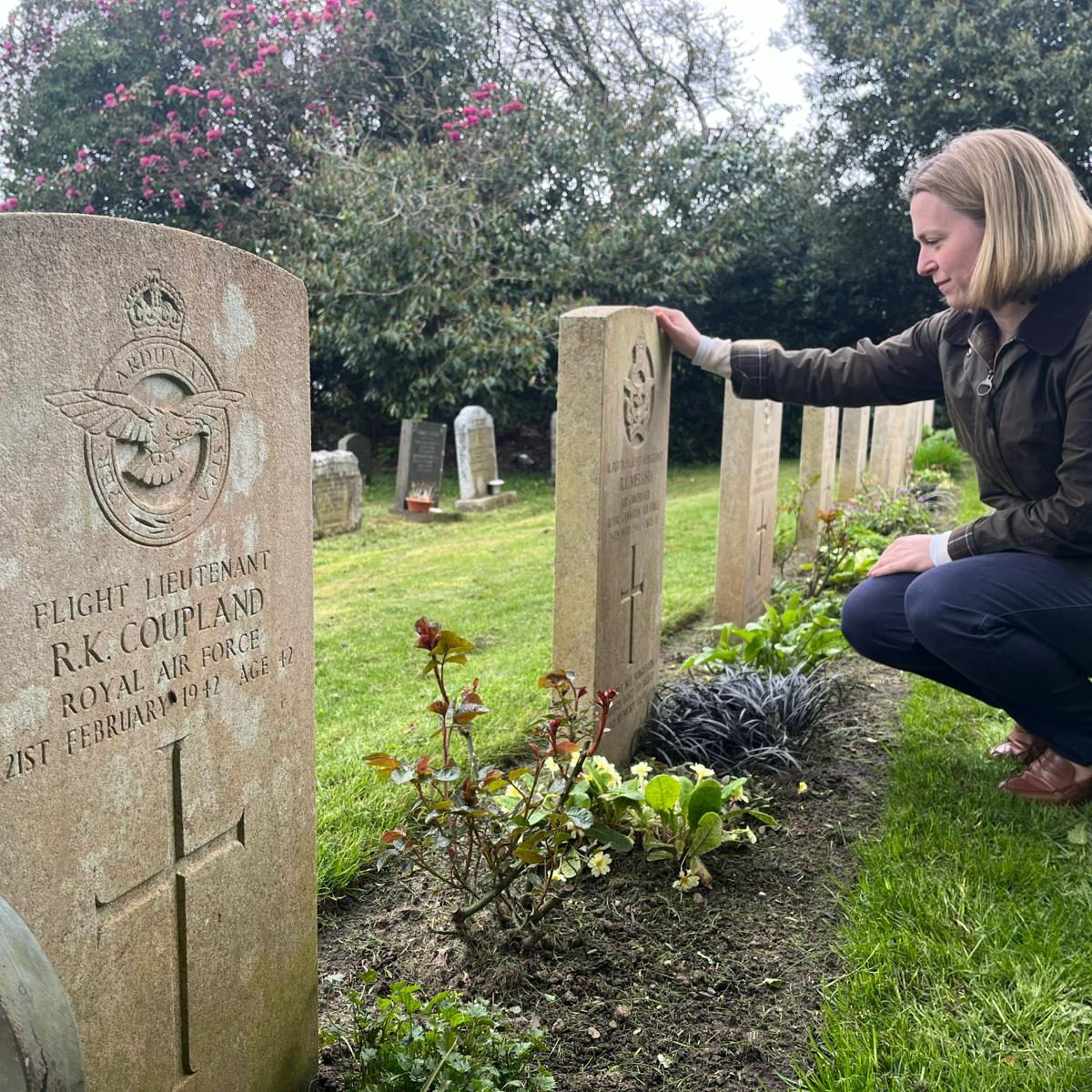
The words carved into thousands of war memorials across the world carry a promise that the fallen will never be forgotten.
“Their name liveth for evermore” – those words appear on the stone of remembrance in Commonwealth War Graves Commission cemeteries and memorials across the globe, a phrase suggested by Rudyard Kipling after the First World War.
For Rebecca Smith, Conservative MP for South West Devon, the inscription captures the enduring legacy of the men and women commemorated at more than 23,000 Commonwealth War Graves Commission sites across 153 countries and territories.
Speaking during a Commons debate on Commonwealth troops, Ms Smith said the memorials serve as a lasting reminder of the global scale of sacrifice during the world wars.
“Today’s debate, ahead of Commonwealth Day on Monday, March 9, speaks to that phrase suggested by Rudyard Kipling, as we remember the legacy of those we commemorate.”
The Commonwealth War Graves Commission, originally known as the Imperial War Graves Commission before its name was changed in 1960, commemorates service personnel from across the Commonwealth who died in the First and Second World Wars.
Ms Smith, who previously worked for the organisation, told MPs that its work ensures every known casualty receives a permanent place of remembrance.
“Every single person we are aware of who died in service in the first or second world war receives either a headstone or a memorial,” she said.
“These are different from village and town memorials. They are specific to the commission.”
The commission commemorates those who died between August 4 1914 and August 31 1921 for the First World War, and between September 3 1939 and December 31 1947 for the Second World War.
Although the war officially ended earlier, some personnel died later from wounds or illness linked to their service.
In her speech, Ms Smith highlighted the often overlooked role played by Commonwealth troops and workers, drawing on stories from the south-west of England.
In South West Devon alone, 137 Commonwealth service personnel are commemorated across 26 sites.
“Of those, 61 are from the first world war, and they served at least five nations,” she said.
Across nearby Plymouth, more than 25,000 service personnel are remembered, most prominently on the naval memorial on Plymouth Hoe, but also in churchyards and villages throughout the city.
Central to preserving those stories is the commission’s “Evermore” project, which gathers information from the public about those commemorated.
“A big part of that is a project called ‘Evermore’,” Ms Smith said.
“Two years ago, I would have struggled to tell these stories, but members of the public have made their contributions, and we now have much more information about the men and women we commemorate.”
Among those remembered is Ernest John Quest, born in Lee Moor, a small village near the china clay works.
Quest had travelled to Australia in his early twenties before returning to Britain during the war to serve as a munitions worker.
“He came back towards the end of the war, and served in munitions, to ensure that we had enough equipment to fight the war,” Ms Smith said.
“He came back at the beginning of 1918 and sadly, by the end of the year, he had died of pneumonia.”
Because he died while working in Britain, Quest was buried close to home in the Methodist graveyard in Lee Moor, with a private headstone placed by his family.
Another story told in Parliament was that of James Wilson, from Yelverton on Dartmoor.
Wilson enlisted in the Australian Imperial Force in 1915 while working as a farmer in Australia and later served in France.
“Sadly, he died just after the war of influenza and pneumonia and was buried in the tiny village of Meavy on Dartmoor,” Ms Smith said.
She also spoke about Charles Allen, an Australian serviceman buried in Efford cemetery, whose grave carries a rare feature.
“He is unique, because I believe that he has the only such grave in the UK with his photograph on it,” Ms Smith said.
“He was a very handsome man. He was killed in 1917, and his granite stone cross in Efford cemetery has a little enamel plate with his photograph on.”
She said the image offers visitors a powerful reminder that the names carved into memorials were real people.
“For those on a tour of the cemetery, it serves to show just who these young men were who lost their life.”
She also highlighted the story of the Tucker family of Yealmpton, where three brothers were killed during the war between March 12 1917 and August 10 1918.
“One is missing – we do not know where he is buried—but his brothers have graves,” Smith said.
“All of them are commemorated by the family back home in Devon.”
Their story, she told MPs, underlines the importance of continuing to share the histories behind the graves.
“We must keep these stories alive; that is more pertinent than ever,” she said.
Ms Smith also pointed to the international nature of the forces commemorated, including Indian, Muslim, Hindu and Sikh service personnel buried in cemeteries across Britain.
She said it was important that communities recognise these memorials as part of their shared history.
“We have graves right around the country of Indian, Muslim, Hindu and Sikh service personnel,” she said.
“Ensuring that communities understand that they are in our midst is very important.”
The contribution of labour units was also significant, including the Chinese Labour Corps.
“A significant contribution was also made by the 140,000-strong Chinese Labour Corps,” she said.
“They came over from 1916 to do a lot of the work on the front, which then freed up the soldiers to do the fighting.”
Responding to the debate, armed forces minister Al Carns said the contribution of Commonwealth forces during the First World War was often overlooked despite its scale.
“The role played by Commonwealth forces in the first world war is pivotal; indeed, it is legendary—an all too often overlooked chapter of our nation’s history,” he told MPs.
Mr Carns said the legacy of those volunteers is commemorated in London at the Memorial Gates on Constitution Hill.
“In memory of the five million volunteers from the Indian sub-continent, Africa and the Caribbean who fought with Britain in two world wars.”
Around three million Commonwealth volunteers fought in the First World War, coming from countries including India, Canada, Australia, New Zealand and across Africa and the Caribbean.
Of the one million people killed while serving under British command during the conflict, nearly a quarter came from Commonwealth nations.
Mr Carns told the Commons that the diversity of those forces showed how people from different backgrounds united during the war.
“Different languages, different cultures and different faiths came together to fight for a common good, demonstrating incredible honour, unbelievable duty and outstanding courage.”
He added that the legacy of those soldiers still shapes Britain’s armed forces today.
“When individuals from the Commonwealth came to fight, it was a huge unifying factor,” Mr Carns said.
“Bombs, bullets and battlefields do not discriminate. They served together, they died together, and now we must focus on how we tell their story to ensure that we live together.”
More than a century after the First World War, Carns said their sacrifice continues to resonate.
“I am pleased that we have had the chance to mark the loyalty, courage and sacrifice of Commonwealth soldiers during the first world war,” he said.
“More than a century later, their legacy still inspires many young men and women.”