A stretch of road in a Devon seaside town has been left propped up by temporary traffic lights for more than two years after a wall collapsed – with frustrated councillors now accusing the county council of “complete silence” over repairs.
The landslip on the A379 in Shaldon happened in February 2024 and the road, which is maintained by Devon County Council, has remained partially closed ever since.
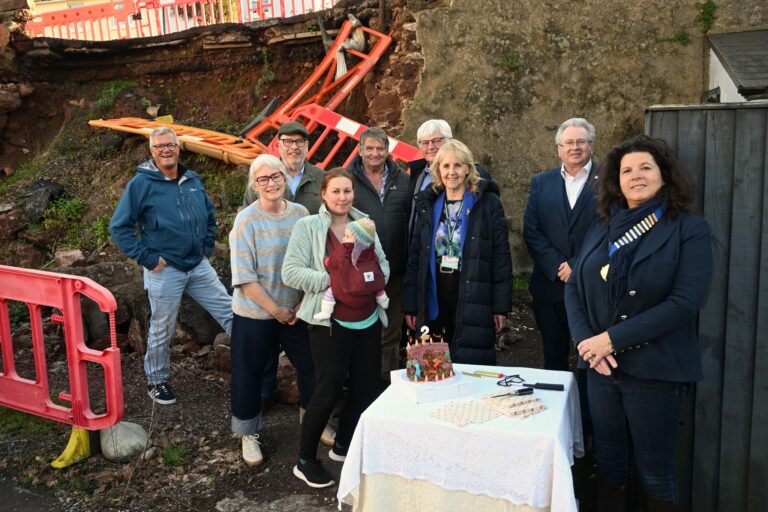
On Tuesday, February 24, parish, district and county councillors held a small gathering at the site – complete with a cake – to mark what they described as two years of inaction and mounting costs.
Shaldon Road collapse (Credit : Alec Collyer)
Devon County Councillor Heather Horner said she had repeatedly tried to press the authority for answers but had struggled to get clear responses.
She said: “I’ve made several contacts with the county council officers. I didn’t get a response. I did a freedom of information request. I asked to see legal documents, but they were refused, I was invited to attend a meeting.”
Cllr Horner said chief executive Donna Manson had reviewed the case and agreed repairs were needed. She said: “She said, ‘Yes, it does need to be repaired, and I will agree to the repair going ahead; however, that does not mean we are taking liability for the costs, that will be sorted out later.”
Horner added that she met the director of environment, climate and highways in November and was told work would go ahead, although no timeline was agreed. Borehole testing was carried out in early December, but she said there had been no further communication despite several follow-up emails.
“Since then it’s been complete silence,” she said. “At the last parish council meeting, it was agreed that we couldn’t put up with this any longer.”
Shaldon Road collapse (Credit : Alec Collyer)
Danielle Westlake, chair of Shaldon parish council, said the prolonged disruption was having a growing impact on residents and businesses. “From the get-go, when it all first collapsed, we put pressure on Devon County Council to repair this problem, and we’re still no further on,” she said.
Westlake said the temporary lights were causing long tailbacks, often stretching to Shaldon Bridge and up the Torquay road, with emergency vehicles struggling to get through. She added that idling cars were frustrating residents and contributing to pollution. “It’s the environmental impact from the fumes is quite something,” she said.
She also raised concerns about rising costs, claiming the bill for traffic management alone was already substantial. “Somebody has estimated they’re way in excess of £50,000 already. That could have gone a long way to fixing this,” she said.
Devon County Council has been approached for comment.
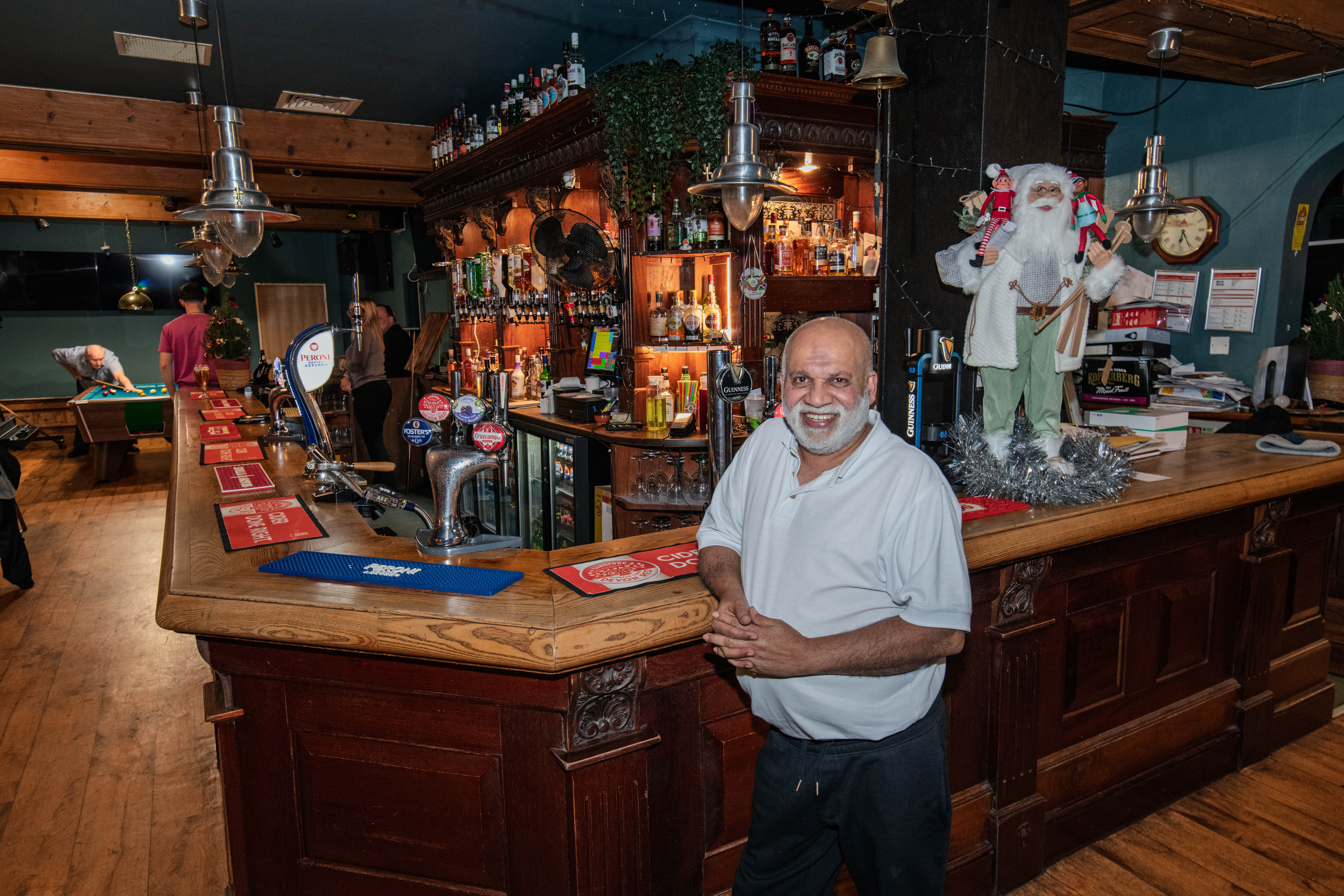
Running a pub for 25 years teaches you one thing above all else; if you don’t adapt, you don’t last.
For Jimmy Sivlal, the long-time steward of The Manor in Cullompton, adaptation has meant turning a once traditional drinking pub into something quite different – a small but bustling food hub designed to keep pace with a hospitality industry that has changed dramatically over the past two decades.
It has been about a year since the latest chapter began. Within the grounds of The Manor now sit multiple food operations: an Indian takeaway, a pizza offering, and a Sunday carvery – all leased out but carefully guided in their early stages by Jimmy himself.
The arrangement reflects both the realities of modern pub economics and Jimmy’s own gradual step towards retirement after a quarter of a century behind the bar.
“It’s about a year now since we opened up Q Spice, which is a takeaway,” Jimmy explains. “At the moment, I’ve leased it to someone, and they run it as their own business. They pay me rent, and they are doing well and have sit-ins as well, but with a limited number of people.”
Pizzas on sale at Stirkz
The concept has proven surprisingly resilient in its first year. Rather than running each kitchen personally, Jimmy has created a structure where individual operators run their own ventures within the same site. The result is a shared destination that offers several food choices under one roof – something that, in his view, Cullompton has long lacked.
“To be honest it’s been great and it is holding its own,” he says. “At weekends we are fully busy. Friday and Saturday we’re fairly busy. We open seven days a week. I initially helped them to get there, and here we are.”
Alongside Q Spice sits Stirkz Pizza, which also began trading roughly a year ago. Like the takeaway, it operates under its own management while contributing to Jimmy’s broader vision for the venue.
The carvery, called About Time Carvery, rounds out the offering and has quickly found its own following. According to Jimmy, the feedback has been strong from the start.
“Our reviews are really good and people enjoy it,” he says. “We recently had a large booking for Christmas dinner at £35 a head which we thought was a fair price.”
Q Spice and Stirkz Pizza menu
Taken together, the different kitchens have effectively transformed The Manor into what Jimmy casually describes as a “food hub”. But the shift was not simply an entrepreneurial experiment – it was, in many ways, a necessity.
“Because the wet trade, it’s diminishing very fast,” he says. “So we had to get into something else and as I’m coming up to retirement, hence I’m leasing everything out, even the Sunday carvery.”
For much of its life, The Manor had been the kind of venue many towns once relied upon; a wet-led pub where drinking formed the centre of the business. At one stage it even operated as a nightclub. But the industry that sustained those models has shifted considerably.
Jimmy has watched that change unfold first-hand.
“It was very much a wet pub and bit of a nightclub,” he says. “The trend has changed very fast, and now the eating side is key.”
Food has become more than just an addition – it is increasingly the foundation that keeps many pubs afloat. Rising drink prices, changing social habits and supermarket competition have all chipped away at the once-dominant bar trade.
“If you buy three pints it’s £15 and you can get a meal for £9.90 so that’s the ratio,” Jimmy says, highlighting the shift in customer expectations.
The Manor House is thriving with sports taking place
The new setup at The Manor is designed to work with those realities rather than fight them. Customers can choose between Indian dishes, pizza, or the traditional carvery, while still using the pub as a place to sit and drink.
The menus themselves occasionally blur those boundaries. Some dishes even combine influences from both kitchens.
“We’ve got the chicken tikka pizza, which comes from the Indian side,” Jimmy explains. “The tikka and the tandoori pizza that’s mixed from Q Spice.”
The Indian menu, meanwhile, remains rooted in traditional cooking.
“The Indian restaurant is very traditional as we are Hindus and offer a different style of food compared to the majority of other restaurants,” he says. “As well as that you can get burgers and kebabs.”
It reflects Jimmy’s personal enthusiasm for food as much as it does a business strategy.
“I like cooking and I like different types of food,” he says.
Practical details have also played a role in the success of the new model. The Manor’s large car park – something many town-centre venues lack – has made it easier for customers collecting takeaway or dining in.
“It’s very positive for Cullompton because there’s hardly anywhere you could go for food and we have a large car park, so that helps a lot,” Jimmy says. “And I think it’s a plus-plus for Cullompton.”
Delivery has become another key part of the operation. Orders can be placed through an online system that offers incentives for customers using the platform.
“At the moment we have got a food hub app which you can order from and get a 15% discount on the Indian and the pizza,” he says. “It’s very reasonably priced. Also, we do deliveries within half an hour for most places.”
Despite the new food focus, The Manor is still very much a pub – just a different kind of one. Instead of loud nightlife, the emphasis is now on a calmer atmosphere built around meals, drinks and social gatherings.
Over the years Jimmy has steered the venue through several major transitions. One of the biggest came when he decided to scale back the nightclub element entirely.
“When I reduced the price of drinks, that hurt a lot of pubs,” he says. “And obviously the police weren’t too happy about that because when people were leaving they were causing a lot of trouble.”
Q Spice in Cullompton
Inside the venue itself, he says, there were rarely problems. But issues outside eventually led to a rethink of the business model.
“That era changed, and we stopped the nightclub, so now it’s purely sit down and drink, and that’s it.”
Looking back across the past quarter century, Jimmy sees survival itself as the achievement he is most proud of.
“Keeping The Manor doors open through challenging times,” he says when asked what stands out.
Those challenges have come in many forms – from economic pressures to the disruption caused by the pandemic.
“We also know how tough Covid-19 was for pubs,” he says. “We had some money come from the government, which helped us a lot.”
In the years since, there has been an ongoing debate about whether the pandemic permanently changed people’s habits.
“When people say that the COVID-19 pandemic stopped people from coming out because they got used to staying at home, I didn’t know how far that is true,” Jimmy says. “I just think it’s just too expensive for people to come out.”
The economics of the hospitality industry have changed dramatically since he first entered it.
“When we started, it was £1.20 a pint, and now our dearest pint is £6.50,” he says. “When you equate the rent, the food, and the fuel, it is so expensive. Then you add entertainment to that as well.”
Supermarkets have added another layer of competition.
“The supermarkets are troubling us as well,” he says. “I mean, things are very, very cheap, I would say, or good prices. So that’s what’s causing a large issue.”
Social habits have evolved, too. Where pubs were once the primary meeting place for young people, technology has changed how relationships begin.
“Before, if you had to find a girlfriend or meet somebody, you had to come to a pub,” Jimmy says. “But now it’s all social media, so they don’t have to come to a pub anymore.”
Through all of those changes, The Manor has remained a constant presence in the town. Jimmy himself has been part of that story for most of the venue’s modern life.
He first arrived in the UK from South Africa around half a century ago.
“It was around 50 years ago,” he says. “My dad was a politician in both South Africa and here in the UK too.”
His path to owning The Manor came about almost by chance.
“When I first came, it was one of my friends who said I should buy The Manor,” he recalls. “I came over, spoke to the landlord, and he was from South Africa, and I’m South African as well. I spoke to him, and he said he would sell it.”
Twenty-five years later, that decision has shaped much of his working life. Now, though, he is preparing to step back.
The transition is already underway. The person currently running the carvery is expected to take over the pub itself once Jimmy retires.
Jimmy adds: “I think it’ll be at the end of the year when that happens.”
For someone who has spent decades navigating the unpredictable world of pubs, the plan for retirement is refreshingly straightforward.
“No,” he says when asked if he has big plans. “Just rest.”
Even so, he remains cautiously optimistic about what comes next – both for The Manor and for the industry more broadly.
“I think it’s a great, great way up,” he says. “Definitely, definitely. Pubs in general are in trouble, but The Manor is holding its own.”
If his recent reinvention of the venue is anything to go by, holding its own might simply mean continuing to evolve one new idea at a time.
Torre Abbey is proud to announce its participation in The National Gallery: Art on Your Doorstep, an ambitious new touring project bringing masterpieces from one of the world’s greatest art collections directly into communities across the UK.
As one of the first four partners selected for the 2025–2026 programme, Torbay will host a unique outdoor exhibition from 6 March – 5 September 2026, showcasing life‑sized reproductions of iconic paintings from the National Gallery. Displayed in a free, open‑air trail stretching from Torre Abbey to Torquay Harbour, the exhibition will celebrate our beautiful seafront while spotlighting the Bay’s rich cultural heritage.
Visitors and residents will have the rare chance to enjoy world‑class art in everyday surroundings. Each work will be reproduced at its original scale, complete with fine‑detail printing and framing, allowing people to appreciate brushwork and composition up close — all without needing to travel to London.
The trail will be curated and designed by Torre Abbey, weaving the artworks into Torquay’s landmarks, heritage spaces, and iconic coastal views. As one of Torbay’s flagship cultural sites, Torre Abbey is delighted to play a central role in hosting this major national exhibition, reinforcing our commitment to inspiring creativity, supporting community engagement, and making art accessible to all.
Throughout 2026, Torre Abbey will host a series of linked events, workshops and exhibitions, offering new ways for audiences of all ages to explore the National Gallery’s masterpieces and deepen their connection to art and heritage.
This project forms part of a wider National Gallery initiative to bring art closer to communities across the UK as part of its Bicentenary and ongoing national partnerships programme. Over the next three years, 12 outdoor exhibitions will take place across all four nations, each shaped by and rooted in its local setting.
Cllr Jackie Thomas, Torbay Council Cabinet Member for Tourism, Culture & Events, and Corporate Services, said: “This is a once‑in‑a‑generation opportunity to bring the magic of the National Gallery to Torquay. We are thrilled to be part of a project that makes art more accessible, inclusive and rooted in local identity. We can’t wait to see these remarkable paintings transforming our seafront and inspiring everyone who lives in or visits the Bay.”
Art on Your Doorstep was made possible with funding from Torbay Council, the National Gallery, the Friends of Torre Abbey, and The National Lottery Heritage Fund.
Using money raised by National Lottery players, The National Lottery Heritage Fund supports projects that connect people and communities with the UK’s heritage. Art on Your Doorstep is made possible with The National Lottery Heritage Fund.
Thanks to National Lottery players, we have been able to bring high‑quality arts experiences directly into local neighbourhoods, helping more people connect with culture right on their doorstep.
Following an inspection last month, Ofsted has rated Torbay Council’s Children’s Service as ‘Good’ overall.
This maintains the Good rating that Torbay was previously awarded by Ofsted in 2022.
The Good rating, following the inspection which took place 12-16 January 2026, applies across all of these areas:
The impact of leaders on social work practice with children and families
The experiences and progress of children who need help and protection
The experiences and progress of children in care
The experiences and progress of children care leavers
Overall effectiveness
The report published by Ofsted and His Majesty’s Inspector, Steve Lowe, who headed up the inspection team, states that “Senior leaders and politicians have a clear strategic intent to achieve what is best for the children of Torbay, addressing the areas for improvement identified at the last inspection.
“Importantly, the change to a more localised, multi-discipline approach has led to improvements in several key areas of practice, with families receiving support to make changes early rather than allowing problems to escalate.”
David Thomas, Leader of Torbay Council said: “This is fantastic news for Torbay and recognises the commitment of everyone here at the Council towards children and young people.”
Councillor Nick Bye, Cabinet Member for Children’s Services for Torbay said: “I am absolutely delighted we have been judged good in all categories by Ofsted following their inspection in January. We can all take pride in the tremendous hard work underway in Torbay to ensure children are safe & can have the best possible start in life. I was especially pleased to hear the positive comments from the Ofsted team who highlighted our work with families, children in care & those who are care-experienced. They were particularly pleased to learn of our new housing for care experienced youngsters.
“I would like to say a personal “thank you” to everyone in the Bay who has contributed to this accolade: professional & political colleagues, our Children’s Services Team, foster carers, partners and a whole host of voluntary & community organisations.
“We are all working together to make Torbay a child friendly place.
“There’s always more to be done but this report acknowledges the progress we have made over the last four years.”
Nancy Meehan, Director of Children’s Services for Torbay Council said: “Our ongoing transformation of our Children’s Services to be the best it can be, through our Families First Partnership working.
“The report also praises our cross-party and corporate support for children’s services as being ‘child-centred’ – highlighting our commitment to corporate parenting and making care leavers a protected characteristic, as well as bringing online new, high-quality accommodation for care leavers and a strong local offer.”
Also mentioned in the Ofsted report is the way clear, visible leadership at the council have communicated the vision and purpose of the transformation of children’s services based on years of planning. The report states that there is a “positive impact of increased early help and family support”, and that “newly formed child in need teams are preventing escalation into statutory processes for an increasing number of families.”
Areas highlighted for improvement include:
The response to children who have suffered long-term neglect
The range and supply of homes for children in care
The frequency and quality of supervision
Though even on these areas the Ofsted report noted that work is already taking place to address the issues: “Senior leaders have begun to harness the creativity and urgency shown elsewhere to address these complex areas of practice.”
We have welcomed the recent announcement from the MHCLG on new funding and flexibilities to accelerate the delivery of social and affordable homes, including a specific allocation to Torbay Council, from the Council Housebuilding Support Fund (CHSF).
The government’s overall package, which includes additional funding, improved borrowing arrangements and updated Decent Homes Standards, aims to support councils and housing providers to increase the supply of good‑quality, energy‑efficient homes and reduce the number of families living in temporary accommodation. This announcement offers valuable measures that can help us to speed up the delivery of much needed affordable homes for local households.
These measures come ahead of this month’s opening of the £39 billion Social and Affordable Homes Programme, which aims to deliver around 300,000 homes over its lifetime, with at least 60% for social rent. Councils – like Torbay – will also find it easier to build again, with the threshold for opening a Housing Revenue Account rising from 200 to 1,000 homes, reducing administrative burdens and helping us to deliver more of the homes we need on brownfield and other infill sites.
Councillor Alan Tyerman, Cabinet Member for Housing and Finance, said: “Torbay Council faces significant costs in providing Temporary Accommodation and housing support for residents for whom we have a statutory duty of care, and the Council has already taken action to provide housing solutions to reduce the number of families and young adults in Temporary Accommodation.
I am therefore pleased to see that the new Social and Affordable Homes Programme will create fresh opportunities to further the provision of homes to enhance lives whilst reducing Council costs. The Council’s intervention will remain focused on brownfield developments and regenerating redundant sites as a way of meeting Torbay’s housing need.
We have already progressed several schemes aimed at delivering new homes, regenerating brownfield land, and improving the quality of existing stock. This includes:
Expanding our own development pipeline, with a focus on delivering genuinely affordable homes for local residents. The first project in a council initiative to turn derelict hotels into rental housing is now complete. Brampton House in Torquay has been transformed into 14 energy‑efficient one‑ and two‑bedroom apartments. We have also acquired and cleared (in preparation for redevelopment) the former Seabury Hotel in Torquay and is working at pace to unlock a range of other sites for new social housing in Paignton, Torquay and Brixham. Construction will also complete on 23-homes for social rent, for older people, at the site of the former St. Kilda’s Care Home in Brixham, later this year.
Working with housing association partners to unlock stalled sites and bring forward new social rent properties.
Investing in temporary accommodation solutions to reduce reliance on costly nightly‑paid placements.
A major package of urban regeneration schemes to revitalise our town centres, including redevelopment of the former Crossways
We will continue working closely with government and local partners to ensure Torbay is well‑positioned to benefit from future opportunities and maximise investment in the Bay. By maintaining a clear focus on regeneration, affordability, and long‑term resilience, the Council aims to build on this momentum and ensure that Torbay benefits fully from the new national programme and the additional tools now available to support local housing delivery.
This will ensure that young people gain the skills, confidence and independence they need to travel safely by bike, supporting healthier habits and lifelong wellbeing.
Recently awarded official training partner status by Bikeability, Active Devon will coordinate delivery across Torbay, supporting schools with cycle training.
A team of freelance Bikeability Instructors will deliver Levels 1, 2 and 3 training to primary, secondary and Special Educational Needs and Disabilities (SEND) schools throughout the Torbay area.
Aaron Harverson, Cycling Champion at Active Devon, supporting the programme, said: “We are delighted to be working with Torbay Council to help deliver this very important initiative. Bikeability training can give children and young people so much more than cycling skills. They gain confidence, improve their ability to respond to different scenarios, and discover a real sense of independence – as well as being supported to move more and be more active now and into the future.”
Councillor Hayley Tranter, Cabinet Member for Adult and Community Services, Public Health and Inequalities at Torbay Council, added: “We are proud to partner with Active Devon to offer free Bikeability training to schools across Torbay. Cycling is an essential life skill, and through this programme we are helping to create safer, healthier and more active journeys for our children. This partnership strengthens our commitment to supporting young people and giving them the tools they need to travel confidently around the Bay and enjoy the benefits of active movement.”
Aaron added: “After completing the Bikeability course, we hope many young people progress to cycle to school regularly where possible, boosting both their physical and mental wellbeing. This training can help children feel more engaged in the classroom and more connected to their community.”
Schools in Torbay that would like to take part and are not yet registered for Bikeability training can contact info@activedevon.org, where a member of the team will be happy to help.
Those interested in becoming a Bikeability Instructor in the area are also invited to email info@activedevon.org to find out more.
Plans have been lodged to install a 25-metre lattice telecommunications tower at the Isca Arena car park in Exeter, in a move aimed at boosting 4G and 5G coverage across the city.
The application, submitted to Exeter City Council by EE Limited and H3G (UK) Limited under prior approval procedures, seeks permission for a “25m lattice tower with six antenna apertures, four 600mm transmission dishes, four equipment cabinets and development ancillary thereto inside an 11m x 11m compound enclosed by Cochrane Clearvu fencing with a double access gate.”
The proposed site is described as Saracens South, Exeter Arena, Whipton. The development would be contained within a secure compound measuring 11 metres by 11 metres.
According to the covering letter submitted with the application, the existing telecommunications apparatus serving the area is currently located on the rooftop of Rennes House, approximately 670 metres south west of the proposed site. However, the document states that “the site is no longer viable as the rooftop is no longer capable of hosting telecommunications equipment.”
As a result, EE (UK) Ltd and H3G (UK) Ltd say they need to find a replacement site “to offset this shortfall in coverage in the vicinity to ensure that network coverage and capacity can be maintained and where possible enhanced.”
The submission explains that the installation forms part of the company’s continued network improvement programme. It states that they wish “to upgrade the current provision to facilitate additional coverage and capacity requirements, incorporating not only 4G but also 5G technology.”
The letter references national planning policy, noting that policy recognises that “advanced, high-quality communications infrastructure is essential for sustainable economic growth.”
It adds that the proposed mast “will have as limited impact on the character and appearance of the area as possible, whilst at the same time engendering positive benefits for local residents, businesses and visitors to and through the area.”
In terms of design, the lower-level equipment is proposed to be finished in green “to blend in with the backdrop of existing trees and hedging immediately adjacent to the site.”
The supporting information outlines the role of base stations in enabling mobile communications, stating: “Without base stations, mobile devices and phones will not work.”
It explains that each base station covers a specific area, or “cell”, and that as mobile devices become more popular, more base stations are needed “to ensure continuous coverage.”
The letter adds that the location “enables the whole of the surrounding area to benefit from improved 5G network coverage and has been designed to be future proof.”
The applicants also state that EE will become the Emergency Services Network provider and that, in order to dedicate the 4G network for that use, there is an intention “to support all users during the current climate and to maintain all current services without the removal of any existing equipment.”
A review of traffic restrictions linked to Sidmouth Folk Week has been launched amid concerns that some measures may no longer meet legal requirements.
Devon County Council has written to Sidmouth Town Council seeking observations on the extent of road closures and parking suspensions imposed during the annual festival, and whether they should be scaled back in future.
In a letter to town clerk Christopher Holland, Richard Pryce, network manager (operations support) in the highways and traffic management group, said the current position was “no longer sustainable” and that a reassessment of the traffic order was proposed .
The correspondence follows a meeting with representatives including John Radford, Ewan Elsden, Cllrs John Louden and Denise Bickley on Monday, February 9, to discuss the annual traffic restrictions used across the town for Sidmouth Folk Week .
Mr Pryce said that while some restrictions involve limited timed road closures for parades and processions, “a significant part of the Traffic Order comprises parking restrictions” .
He wrote that these restrictions had “broadly grown over the years due to public representation” and now cover a variety of residential streets, “some a considerable distance from Sidmouth town itself” .
The reasons cited for the increase include facilitating traffic flow, preventing visitors parking in certain residential streets and tackling anti-social behaviour from people sleeping overnight in vehicles .
However, Mr Pryce said some parking restrictions during the festival “do not logically translate to being the responsibility of those managing the event”, noting that Sidmouth is naturally busy with tourists during the summer months .
He added that Sidmouth Folk Week attracts a number of “fringe events” with musicians and stalls appearing across the town, often promoted by local businesses. These are not under the auspices of the managed event but are sometimes perceived as part of it .
Mr Pryce said representations had been made that the inclusion of many parking restrictions outside the town were unnecessary to facilitate the event and, in some cases, “only act to appease some residents” .
He pointed out that, under the Road Traffic Regulation Act 1984, event-related restrictions can only be used to:
Facilitate the holding of an event
Enable members of the public to watch an event
Reduce the disruption to traffic likely to be caused by an event
“It is questionable that some existing parking restrictions adequately meet the requirements set in legislation,” he wrote .
The county council has proposed reviewing all parking restrictions within the current order to assess which meet the legal criteria, before beginning a process of “rationalising the Order in line with the set criteria” .
A copy of the detailed specifications used in the last Sidmouth Folk Week traffic order has been provided to the town council as part of the assessment .
According to the attached specification for 2025, road closures were scheduled between Thursday, July 31 and Saturday, August 9, with specific timed closures in Market Square and along the Esplanade for processions and events. Temporary one-way traffic was also implemented in parts of the town, alongside parking suspensions on a number of roads and a 20mph speed restriction on part of the B3176 .
Mr Pryce has asked for observations and feedback from Sidmouth Town Council by Friday, April 3, 2026
Councillors have set a balanced budget which will enable the authority to deliver on its priorities for the year ahead.
At the annual Council Budget meeting at the Guildhall, Council Leader Phil Bialyk said consultation with residents and communities had helped to shape the proposals.
The city council’s share of an average band D Council Tax bill for 2026/27 is £191.31 – 7.6% of the total. It has increased by 2.99 per cent or £5.55 a year – around 11p a week.
Cllr Bialyk said: “We have continued to deliver excellent services of residents and communities in the city. Despite everything we do as a local authority, Exeter continues to set one of the lowest Council Tax rates in the country.
“After years of tough and difficult decisions, we are in an enviable position of not having to cut services for the remaining life of this Council.”
Cllr Bialyk said the budget demonstrated how the Council is delivering on its key priorities:
Supporting residents through the cost of living
Leading on climate action
Building more council homes
Protecting green spaces
Investing in culture and leisure
Running a stable, well-led council
Councillors heard that a number of major projects were expected to get underway over the next year.
The council is planning to expand and relocate the Materials Reclamation Facility (MRF), progress plans for a new Wonford Community and Learning Centre, and relocate the Civic Centre to the Council-owned Senate Court offices in Southernhay.
The Leader also announced the creation of a new temporary fund to enable residents and community groups to improve their neighbourhoods.
The council is putting £130,000 into Pride in Exeter – the equivalent of £10,000 for every ward – to be spent on tidying, cleaning and improving areas in the city.
Residents and community groups will be encouraged to apply for things like fixing broken fences, clearing overgrown spaces, removing excessive weeds and general small repairs and tidying and general improvements.
Cllr Bialyk said: “Exeter is already a clean and tidy city, but with more resources there’s always more than can be done. The work will be carried out by our dedicated teams at the Council, in conjunction with community groups where appropriate.
“This extra resource is in addition to all the usual cleansing operations the Council carries out – it is extra resource for non-essential but important work that improves the quality of life for residents in our communities. It is about having pride in our city, to ensure that Exeter continues to look the best it can be.”
In his budget speech, Cllr Bialyk also highlighted achievements over the past year, including:
£526,300 awarded to 4,848 households to help with the cost of living
Retrofitting 152 council properties, bringing the total in the city to 1,250
Increasing membership of Exeter Leisure to 13,6461 – a 16 per cent rise on last year
Increasing casual leisure users to 64,429 – a 20 per cent rise on last year
Welcoming 800,000 swimmers to the council’s pools
Collecting 99.9% of waste was successfully
Continuing food waste collections – now rolled out to around 44,000 homes
Cleaning up 629 cases of graffiti
Planting 799 trees
Investigating 877 noise complaints
Following the budget, the overall bill for a band D property in Exeter for 2025/26 will be £2,495.36 – an increase of £109.91 or 5.01%.
The breakdown of this charge is:
Devon County Council – £1,891.17
Office of the Police and Crime Commissioner – £303.20
Exeter City Council – £191.31
Devon and Somerset Fire Authority – £109.68
Cllr Bialyk added: “Our share of the council tax bill is £191.31 – that’s £3.67 a week. I think that is pretty good value for a city which does so much, and we will continue to ensure that we provide the very best services we can for the benefit of everyone in Exeter.
“As people will be aware, Exeter City Council will be replaced by a new unitary authority in 2028 under plans for local government reorganisation.
“Our legacy will be handing over this authority in a sound way. Under our leadership Exeter has thrived in the past, and I know that it will continue to thrive in the future.”
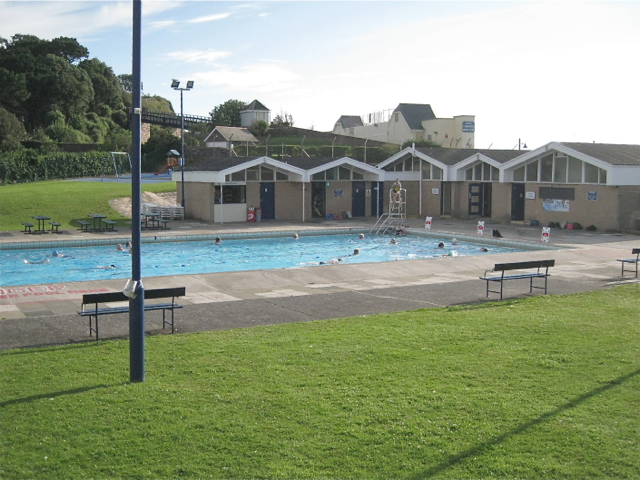
A packed public meeting heard calls for a community takeover of a seaside lido after councillors agreed to reconsider a controversial decision to close the facility.
Teignbridge District Council’s executive voted in February to shut Teignmouth Lido in a bid to save £74,000 a year, prompting strong opposition from residents and swimmers.
However, a special meeting of the council’s scrutiny committee heard repeated pleas from a packed public gallery to keep the pool open and explore transferring it to a community group.
Councillors voted to formally ask the executive to reconsider the decision.
The council’s deputy leader said it was good to see “democracy in action” and confirmed the executive would listen again to the evidence before deciding whether to overturn the closure.
Campaigners later held a public meeting at Teignmouth Rugby Club, attended by more than 200 people, to outline plans for a volunteer-led trust to run the pool if the council allows it.
Daniel O’Connell, from the Save the Lido group, said the turnout showed how important the facility was to residents and businesses.
Daniel said: “We have got more than 200 people here, which hopefully shows the importance of what the lido means to the community in Teignmouth and the surrounding towns and villages.
“It is not just about the people who live here. For businesses, the lido is a great selling point. Hotels and B&Bs can promote the fact there is a lido here as part of the visitor experience.”
Earlier the same day, councillors discussed the closure decision during a scrutiny meeting.
Daniel said: “The decision has now gone back to the Teignbridge executive next week for them to reconsider their decision.
“A few councillors from the executive came to us afterwards and said they might have made a mistake. They were surprised by the level of support.”
The outdoor pool reopened in May 2023 after being closed for three years while £800,000 of renovation and decarbonisation work was carried out.
Campaigners believe the upgrades could allow the facility to operate for longer each year.
Daniel said: “That system should generate enough energy to keep the pool open for longer hours than the current season, which usually runs from the end of May to the end of August.
“We often have great weather in September and October, so we would like to explore extending the season.”
A working group was formed around 14 months ago to explore options for protecting the pool if closure was proposed.
Daniel said: “We spent time gathering information and monitoring the situation behind the scenes. Then in January the council agenda showed they were considering closing the lido and disposing of it, which was when we formally came together as a group.”
The group has secured “asset of community value” status for the site, giving communities time to prepare a bid if the property is put up for sale.
Daniel said: “That status means the council cannot dispose of the asset on the open market for up to six months.
“It does not give us the right to buy it, but it gives the community a chance to come forward.”
Campaigners believe the facility could be run by volunteers alongside paid staff, similar to other community-run lidos across the country.
Daniel said: “There would still be paid roles. We cannot expect people to lifeguard for free all the time. But volunteers could help with other roles and support the operation.”
Supporters at the meeting also heard from members of the proposed management team, including lifeguards, swimming instructors and volunteers with experience in operations, governance and construction.
Adrian Eastman said he had previously helped a community group take over a lido elsewhere.
Adrian said: “The council had let the pool run down and said it was not viable. The community took it over as a trust and it became extremely successful.”
During the meeting, Penny Lloyd said local MP Martin Wrigley supported the campaign but had been unable to attend.
Penny said: “Martin Wrigley is totally behind the whole scheme and wanted everyone to know that. If he had not been in Westminster dealing with international matters he would have been here tonight.”
Campaigners are considering launching a crowdfunding scheme if they are given the opportunity to operate the pool.
Daniel said: “What we do not want is a ‘give us your money’ campaign. The idea behind crowdfunding is that people receive something in return.
“For example, if someone donated £20 they might receive a free family swim ticket or a ‘Save the Lido’ T-shirt.”
He said the group’s aim was to demonstrate the pool could at least break even if it was run differently.
Daniel said: “If at the end of the year we make £1, that is a win.”