



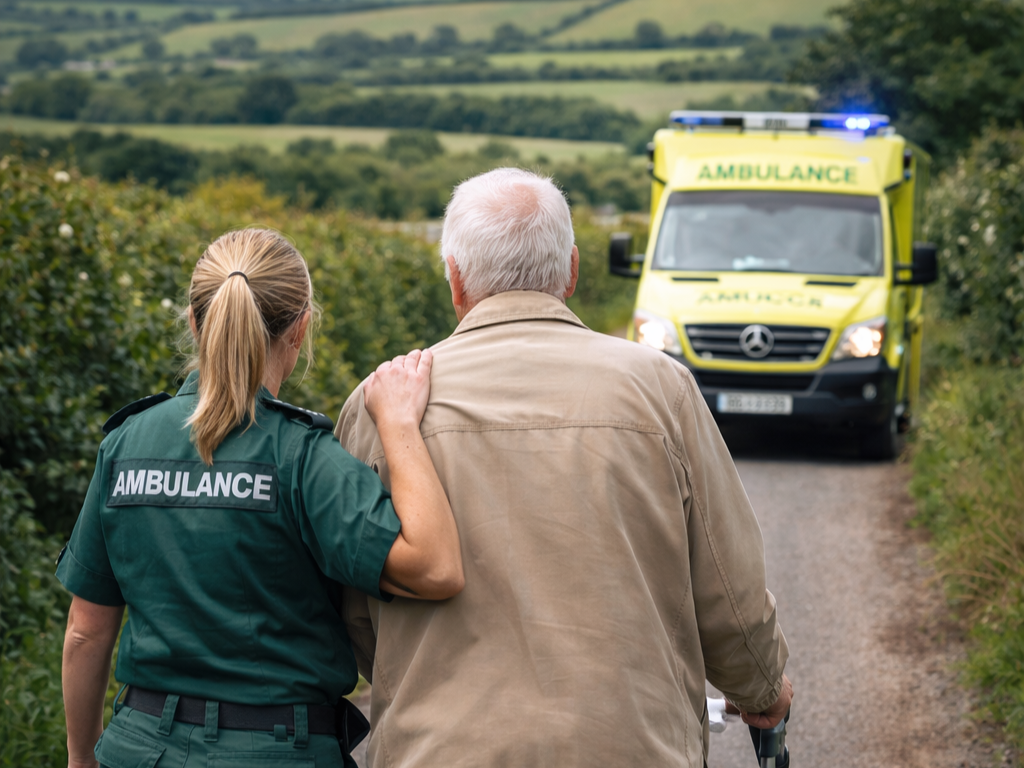
The realities of accessing healthcare in Britain’s countryside were laid bare in Parliament as MPs described long journeys to hospitals, dwindling local services and growing pressures from ageing populations.
During a Westminster Hall debate on rural healthcare, MPs warned that geography, transport and workforce shortages are creating barriers that many rural residents struggle to overcome.
Rachel Gilmour, Liberal Democrat MP for Tiverton and Minehead, told MPs that the demographics of rural communities often compound those difficulties.
“I represent a disproportionately elderly population, which brings with it great wisdom as well as greater health challenges, particularly given that parts of my constituency are some of the least densely populated in England,” Ms Gilmour said.
She said transport problems were a significant obstacle to care for many residents.
“Shabby transport connectivity hobbles every aspect of my constituents’ lives,” Ms Gilmour said.
“Perhaps no more acutely is this reality felt than in access – or the lack of access – to healthcare.”
For some patients, simply reaching hospital can involve long journeys and high costs.
“For people in the West Somerset corner of my constituency, it can take two hours and two buses to reach Musgrove Park hospital in Taunton,” Ms Gilmour said.
“I am told that a return fare would cost my constituents an eye-watering £180 in a taxi, which is simply unaffordable to most local people.
“These barriers delay diagnoses and treatment.”
Ms Gilmour also criticised a decision not to permanently install a CT scanner in Minehead.
“I am thankful to the Minister for Care for being a responsive member of his Government, but I cannot hide my disappointment at the decision to snub Minehead’s calls for a permanent CT scanner installation,” Ms Gilmour said.
“The decision was supposedly reached because such a move was deemed uneconomical.
“It proved to be a game changer for so many local people, but it is indeed uneconomical because terrible transport links suppress demand.”
She urged ministers to reconsider how remoteness is factored into healthcare funding and planning.
“To conclude, remoteness has not been given the weighting it should in the Government’s local government funding settlement,” Ms Gilmour said.
“I implore the Government—and I hope the Minister takes this away—to undertake a real, forensic look at just how important rurality and remoteness is as a factor for the cost of healthcare delivery in rural areas.”
Richard Foord, Liberal Democrat MP for Honiton and Sidmouth, also highlighted the structural challenges facing rural healthcare.
“Neighbourhood health hubs need to apply to proper neighbourhoods – things that we would identify with,” Mr Foord said.
“In rural areas we would identify with towns of 10,000, not 50,000.”
Mr Foord warned that rural healthcare challenges often go unnoticed in national policymaking.
“There are unique challenges associated with rural healthcare, and all too often it feels like those challenges are invisible from Westminster and Whitehall,” Mr Foord said.
“Rural and coastal areas are not the same as urban areas.”
He said communities were increasingly struggling to access basic health services.
“After years of neglect by the Conservatives, it feels like rural communities, including those in Devon, are increasingly cut off from GPs, ambulances and cancer treatment, and the decline continues,” Mr Foord said.
Mr Foord pointed to regional data showing the scale of the issue.
“The south-west already has the fewest GP practices of any region,” he said.
“It also experienced the largest percentage fall in the number of GP practices—2% of practices in the south-west closed between 2024 and 2025.”
According to research cited by the Liberal Democrats, rural patients also face longer waits for emergency and specialist care.
“Waiting times for life-threatening ambulance calls are 45% longer in rural areas,” Mr Foord said.
“Waits of four weeks or more for cancer diagnoses are three times longer in rural areas.”
Travel to GP services can also be significantly longer.
“Just getting to the GP takes longer – a third longer by car and twice as long by public transport,” he said.
“That disparity is set to rise if we continue to see bus routes curtailed and rail infrastructure left to crumble.”
He added that in some communities the problem is particularly severe.
“Honiton and Sidmouth, which I represent, sits in the bottom quarter of constituencies in the country for access to healthcare by public transport, walking or cycling,” he said.
“The village of Stockland, for example, is in the bottom 0.2% nationally for transport access to healthcare.”
He also highlighted the pressures on carers and families dealing with dementia in rural areas.
“In Honiton and Sidmouth 1.6% of patients have been diagnosed with dementia, whereas the national average is just half that—0.8% across England as a whole,” Mr Foord said.
Mr Foord referenced the work of local volunteers supporting people with dementia.
“My constituent Heather Penwarden is the chair of Dementia Friendly Honiton,” Mr Foord said.
“She says that dementia care in Devon ‘seems at an all-time low’.”
He described the experiences shared by carers.
“One carer, through tears, asked Heather: ‘How bad does it have to be before I get some genuinely helpful and sustained support in looking after my dear husband through his dementia?’”
The group previously raised £350,000 to fund a specialist Admiral nurse role, but Mr Foord said there was little chance of replacing it following a freeze on NHS recruitment.
Responding to the debate, care minister Stephen Kinnock said rural communities face distinct health challenges.
“We know that the NHS faces pressures all over the country, with rural communities experiencing unique health and wellbeing challenges shaped by geography, demography, infrastructure and access to services,” Mr Kinnock said.
He said the Government’s ten-year health plan aims to reshape the NHS through three broad shifts.
“Our 10-year health plan is a commitment to rewire our NHS,” Mr Kinnock said.
“The three shifts – from hospital to community, sickness to prevention and analogue to digital – will support neighbourhood and community health services in getting the investment they need.”
Mr Kinnock said services would need to be designed differently depending on local circumstances.
“We recognise that neighbourhood services will need to look different across rural and urban areas to best meet the needs of each community,” he said.
“That is why their delivery will be locally led, with local systems determining how neighbourhood health is designed for their area.”
He also highlighted additional investment in primary care and workforce expansion.
“We are investing over £480 million extra into GP services this year,” Mr Kinnock said.
“Since October 2024, we have invested £160 million into the additional roles reimbursement scheme, which has supported the recruitment of over 2,000 GPs.”
Mr Kinnock added that the Government is also taking steps to address shortages in dental services and emergency care.
“We know that patients are struggling to access NHS dentistry services, particularly in rural areas,” he said.
“To address that, we are reforming the dental contract to match resources to need and to improve access.”
He said ministers recognise the scale of the task ahead.
“We absolutely recognise the challenges, and we recognise that we still have a mountain to climb before we can get our NHS back on its feet and fit for the future,” Mr Kinnock said.
He added: “We believe that through the three shifts—from hospital to community, treatment to prevention and analogue to digital—and the strategies that we are pushing through on workforce, digital, better support for general practice, and neighbourhood health, we can get our NHS back on its feet and fit for the future.”