



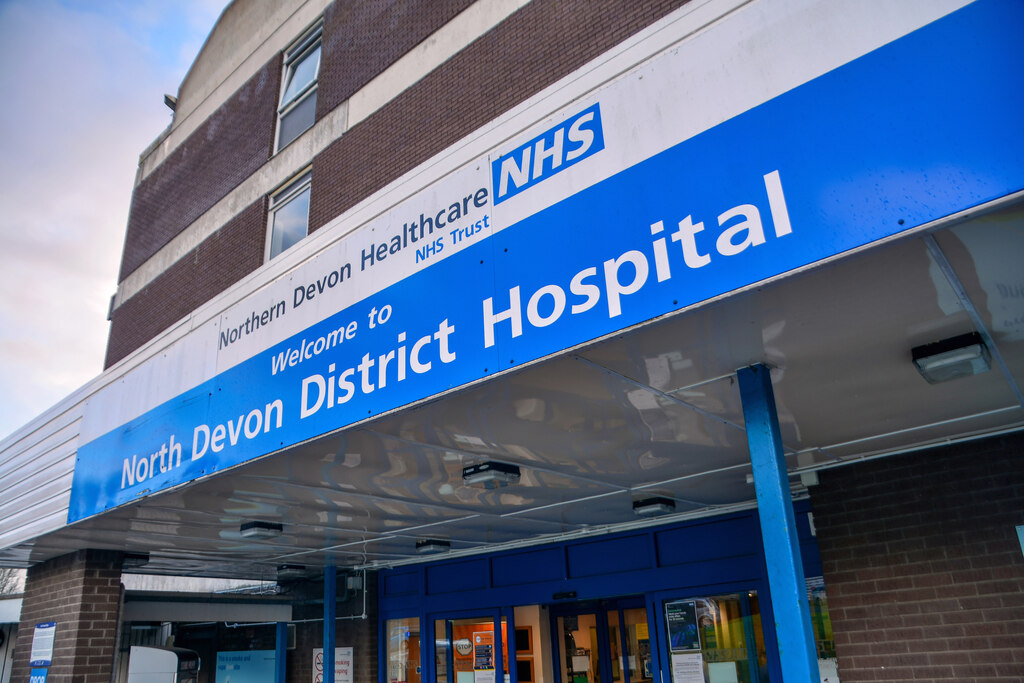
A debate over the future of NHS infrastructure has laid bare the growing strain on hospitals across the south-west, where ageing buildings, failing equipment and years of underinvestment are now colliding with rising demand for care.
Speaking during a parliamentary debate on NHS capital spending, Liberal Democrat MPs warned that hospitals in Devon are struggling with deteriorating estates and outdated equipment – while ministers argued that new funding commitments will begin to reverse the trend.
Caroline Voaden, Liberal Democrat MP for South Devon, said hospitals are increasingly forced to choose between replacing worn-out equipment and investing in new technology that could transform patient care.
“Medical devices and equipment are increasingly becoming pressure points as trusts rely on ageing, life-expired kit,” Ms Voaden said.
She pointed to the experience of Torbay and South Devon NHS foundation trust, which had been able to trial cutting-edge surgical technology but could not afford to adopt it permanently.
“Torbay and South Devon NHS foundation trust has had fantastic results in bowel surgery from a free trial of a robotic surgery system that it was offered, but it cannot afford to buy the system because it has to replace other equipment that is on its last legs,” she said.
Ms Voaden urged ministers to clarify how future capital funding would support innovation as well as maintaining existing hospital estates.
“The Minister should set out how the Government will ensure that NHS capital policy supports not just buildings and maintenance backlogs, but clinical equipment and the technology needed to deliver safe, high-quality, innovative care for patients.”
The debate also heard stark warnings about the condition of Torbay hospital itself, with Steve Darling, Liberal Democrat MP for Torbay, describing the state of the site as one of his top priorities since entering Parliament.
“Sorting out Torbay hospital, the hospital that serves my constituency as well as the constituents of my hon. Friends the Members for South Devon (Caroline Voaden) and for Newton Abbot (Martin Wrigley), is my No. 1 priority as the Member of Parliament for Torbay,” he said.
Mr Darling told MPs he had been shocked by the scale of the problems he encountered.
“I knew that the hospital was in a difficult place prior to my election, but as I began to immerse myself in the challenges facing it, I was shocked,” he said.
“I was shocked by what was effectively wanton vandalism – corporate vandalism, even -undertaken by the previous Conservative Government by making promises that they just could not keep.”
He argued that years of underinvestment had left the health service facing far greater costs now.
“The vandalism – the fact that they chose not to invest – made it much harder to invest in the longer term and actually made it more costly. It is that old proverb: a stitch in time saves nine.”
Among the most striking examples cited was the condition of Torbay hospital’s infrastructure.
“In Torbay we face some massive challenges,” Darling said. “We have seen more than 700 sewage leaks at our hospital.”
“These sewage leaks do not just happen in the corridors; they happen in clinical areas and affect wards where patients are.”
He added that the consequences were directly affecting patient care.
“There have to be deep cleans, and there are delays for patients in getting on to lists and, most importantly, delays in supporting people who need medical interventions.”
Even visible construction work at the hospital, he said, was misleading.
“Approaching the hospital, someone might think that the seventh cavalry was coming over the horizon – the tower block is wrapped in scaffolding, so it must be being sorted,” Mr Darling said.
“However, the reality is that the £1 million scaffolding is there purely to stop bits of the building falling off and braining staff and members of the public as they go past.”
Despite those challenges, Darling acknowledged areas of progress within the hospital.
“I also want to reflect on what works well in Torbay hospital,” he said, highlighting investment in the emergency department and improvements to endoscopy services.
“We have seen investment in the endoscopy unit, and 90% of patients are being seen within five weeks, which is a massive improvement.”
However, he warned that the scale of the estate problems remained significant.
“Looking at the estate of Torbay hospital as a whole, 85% of it is not up to standard,” he said.
“The £350 million investment supports only half of the hospital.”
Darling also argued that broader economic factors had eroded the real value of hospital building programmes.
“We have also seen a toxic change to the spending power of this capital programme,” he said.
“We have seen Brexit, we have seen the pandemic, which has impacted on the spending power of capital programmes, and we have seen the war in Ukraine, which has seen building prices spiral.”
“Some of the management in the hospital field say that, since the pandemic, the spending power of capital programmes has halved.”
He warned that the consequences were felt most sharply in poorer communities.
“In conclusion, Torbay is one of the most deprived communities in the country and the NHS often picks up the rough end of that,” Mr Darling said.
“Only recently, a director told me she has patients who believe that living to their 60s is a good span of life.”
“I am sure the Minister agrees that is not the aspiration we should have for our communities.”
Similar concerns were raised about the future of North Devon district hospital by Ian Roome, Liberal Democrat MP for North Devon.
Mr Roome said the hospital faced a decade-long wait for major rebuilding work.
“The hospital is now the third of nine hospitals in wave three of the new hospital programme and faces a further 10-year wait for the capital funding it needs,” he said.
“That investment is desperately needed to replace an ancient intensive care unit and operating theatres that are nearly 50 years old.”
While welcoming an initial phase to build new staff accommodation, he warned the main redevelopment could still be many years away.
“On paper, however, phase two is unlikely to begin before 2035.”
Maintaining ageing buildings until then, he said, could become increasingly expensive.
“Our hospital has a maintenance backlog of ‘high’ and ‘critical’ grade work of over £40 million, the most per square metre of any hospital in the south-west,” Mr Roome said.
“Our NHS trust worries, as I expect many people in this Chamber worry, that that is simply throwing good money after bad.”
Responding for the Government, minister for secondary care Karin Smith acknowledged the scale of the infrastructure challenge facing the health service.
Quoting Lord Darzi’s review, Smith told MPs: “The NHS has been starved of capital and the capital budget was repeatedly raided to plug holes in day-to-day spending…Some £4.3 billion was raided from capital budgets between 2014-2015 and 2018-2019.”
“The result has been crumbling buildings,” she added.
Ms Smith said the Government had already committed to significantly increasing capital investment in the health service.
“The Chancellor has made her key decision to put us back on track, announcing in the Budget that capital health spending would increase by £15.2 billion by the end of the spending review period in 2029-30,” she said.
She added that new rules had been introduced to ensure capital budgets are no longer diverted into day-to-day spending.
“As a result, capital funding will now be fully focused on repairing, upgrading and expanding NHS buildings and facilities to support long-term productivity.”
Ms Smith also confirmed long-term funding commitments aimed at giving hospitals more certainty.
“That change means there is a £30 billion commitment in capital funding over five years to support the day-to-day maintenance and repair of the estate,” she said.
For the first time, she added, NHS organisations would receive multi-year capital allocations to help them plan major projects.
“This is an unprecedented opportunity for local health systems to plan with confidence over a nine-year period.”
But she acknowledged that rebuilding NHS infrastructure would take time.
“Of course, rebuilding NHS infrastructure cannot happen overnight,” she said.
“I assure hon. Members that the Government do understand that long-term certainty over capital funding is needed for the NHS to move from these short-term fixes to more strategic investment.”