



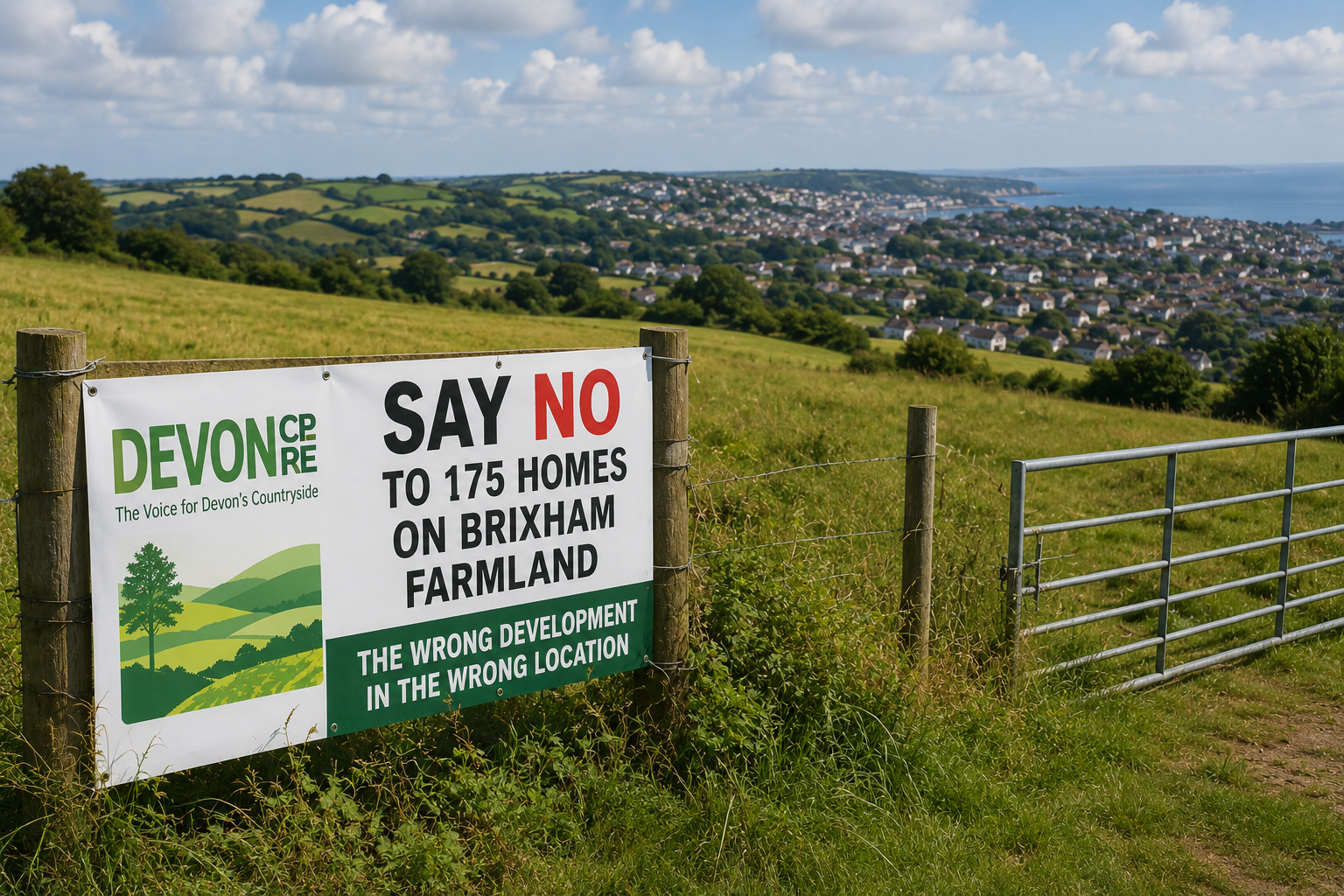
The charity that campaigns against unwanted and inappropriate development across Devon has submitted a comprehensive objection to Torbay Council outlining numerous reasons why proposals should be refused to build 175 homes on agricultural land within the protected South Devon National Landscape, on the western side of Brixham.
Devon CPRE objects to such a large development within the National Landscape, stating that submitted plans for Monksbridge Park in Mathill Road conflict with national planning policy and the adopted local development plan. The latter places significant emphasis on landscape-led development and high-quality contextual design; however, the scale, density, and spatial extent of the developer’s outline proposal appear to be driven primarily by maximising site yield.
The Landscape and Visual Impact Assessment identified significant adverse effects on the South Devon National Landscape and its setting during construction and early occupation phases, including within the wider valley landscape around Brixham. Devon CPRE says the developer’s description of effects as “localised” underplays their impact and claims the plans lack robust evidence demonstrating that long-term landscape harm will be avoided or acceptably mitigated.
Furthermore, the charity says the proposal does not comply with a strong policy (Policy SC4: Sustainable Food Production and Land Protection) in favour of protecting Best and Most Versatile (BMV) agricultural land, supporting local food production and ensuring that development on higher-quality agricultural land is only permitted where there is an overriding need and no reasonable lower-grade alternative.
Devon CPRE Director Penny Mills says, “Recent CPRE research showed there was enough brownfield land in Devon for 16,700 houses. The priority should be to prioritise the use of these previously developed sites before any more green land is concreted over for housing – particularly in the setting of a National Landscape. More than 370 objections to the Monksbridge Park development have already been logged on the Torbay Council website. So the message is clear: this is the wrong development in the wrong location.”
She adds, “CPRE is celebrating its centenary this year. For 100 years our charity has steadfastly fought inappropriate development in our countryside. Here in Devon, we have so many precious landscapes and productive farmland that should be protected for future generations because there are plenty of other sites for new homes. We support communities across the county with such applications and have recently helped residents in Westleigh in North Devon successfully fight off plans for new homes on the edge of their village. We would urge people in South Devon to join us as members to support our fighting funds.”
Councils are responsible for ensuring that sufficient planning permissions are granted to meet local housing need over the next five years. At the moment, Torbay Council only meets the need for less than two years. Devon CPRE’s objection acknowledges that the absence of a five-year housing land supply is an important material consideration. However, it says the presumption in favour of sustainable development does not override the statutory and national policy protections afforded to the National Landscape.
To find out more about Devon CPRE’s work to protect the countryside and how to support the charity, visit: cpredevon.org.uk